

Health Insurance for German Expats in France
Plans from April International, Allianz, AXA, Cigna, and Bupa are among the best health insurance plans for German expats in France. Each provider offers different levels of coverage, benefits, and limits, allowing you to choose a plan that best fits your needs.
Discover the world's top
health insurers.
Compare quotes with
a click of the button.
Are you a German citizen moving to France and looking for ways to access quality healthcare? Wondering how to stay protected and manage healthcare costs while living in France?
In this Pacific Prime article, we’ll cover everything you need to know about health insurance for German expats in France, including an overview of the country’s healthcare system, insurance requirements, coverage options, recommended plans, and average costs.
Understanding France’s Healthcare System

France operates a dual public–private healthcare system that delivers high-quality care to its residents. All legal residents are entitled to public health insurance through the Carte Vitale.
The public system operates as a co-payment system based on reimbursements. Patients typically pay upfront for their treatment and are later reimbursed partially or fully by the Sécurité Sociale according to standardized rates, known as the BRSS (base de remboursement de la Sécurité Sociale).
Unlike Germany, France’s universal public system works closely with the private sector. For example, patients with a Carte Vitale can receive care at private facilities but may face higher out-of-pocket costs due to different reimbursement rates.
To cover these additional expenses, many residents and expats choose private supplementary insurance (Mutuelle), which helps with excess fees, private room charges, and services not fully reimbursed by the public insurer.
Public vs. Private Healthcare in France
France provides healthcare through both public hospitals and private clinics. Public hospitals are not-for-profit and regulated, while private clinics can be non-profit or for-profit, sometimes charging higher fees or offering specialized services.
Unlike in some countries where public and private facilities differ greatly, in France, your doctor can refer you to either type, and the quality and speed of service are generally similar. You can also usually book an appointment with any GP during their working hours.
Patients typically pay upfront for services and are reimbursed by the Sécurité Sociale according to standardized rates. This system ensures consistent coverage and predictable costs across both public and private healthcare facilities.
Can German Expats Use Public Healthcare in France?
German expats can use public healthcare in France by registering with the French social security system, la Sécurité sociale, if they are legal residents and have lived in the country for at least three consecutive months.
After meeting the residency requirements, German expats must register with the Caisse primaire d’assurance maladie (CPAM), which is the public health system under their social security benefits.
Required documents include an EU national ID, birth certificate, proof of residence in France, French bank account (for reimbursement), completed registration form, and employment contract or payslips (if working).
The registration process depends on your employment status in France.
- If you are employed in France, you must complete and submit form S1106 to the local CPAM office, along with the documents listed above, plus your employment contract and, if possible, your first payslip.
- If you are not employed (retired, job-seeking, or living with family), you must obtain an S1 form from your current social security scheme in Germany. Attach the same supporting documents, except for the employment contract and payslip, then register the S1 form with your local CPAM office.
Healthcare Costs in France
The state heavily regulates healthcare costs in France. The standard fee for a GP visit in France is €30, and specialist consultation rates range between €40 and €75, depending on the specialty. The table below shows common healthcare costs in France.
| Type of Service | Estimated Costs |
| General Doctor Consultation | €30 |
| Specialist Consultation | €40–€75 |
| Health Checkup (EPS) | Free |
| Hospital Stay (Forfait hospitalier) | €20 per day |
| Hospitalization | Up to €3,000 per day |
| Cataract Surgery (per eye) | ~€400 (insured) / up to €3,000 (uninsured) |
Health Insurance Options for German Expats in France
All residents in France, including expats, are required to be registered with the public health insurance. Still, additional or alternative insurance is available as an option for German expats in France.
Protection Universelle Maladie (PUMA)
This is the basic mandatory coverage provided by L’Assurance Maladie. If you work in France, contributions are automatically deducted from your salary. Those who are unemployed or have low income can apply for free coverage.
Public insurance generally reimburses around 70% of general practitioner costs, 80% of hospital visits, the full cost of pregnancy and childbirth, and, in some cases, the full cost of certain medications.
Mutuelles (Supplementary Health Insurance)
Even with public coverage, healthcare in France is not completely free. A mutuelle is an additional insurance policy that helps cover these extra expenses, including copayment, private room charges, or treatments that aren’t fully reimbursed.
Both French locals and expats choose a mutuelle to reduce their out-of-pocket expenses and get more comprehensive coverage.
International Private Health Insurance
For expats who travel frequently, are not yet covered by public insurance, or want additional benefits, international private health insurance is an alternative. These plans provide higher annual limits and expat-focused benefits such as medical repatriation and multilingual support.
They can either complement public coverage or temporarily cover your healthcare needs while waiting for PUMA registration.
Best Health Insurance Providers for German Expats in France
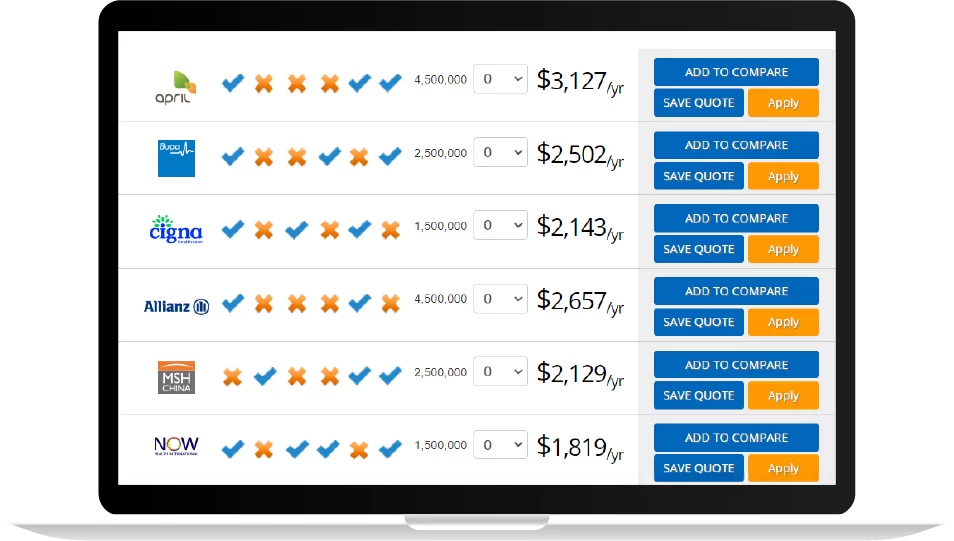
Several leading international insurers, including April International, Allianz, AXA, Cigna, and Bupa, offer comprehensive health insurance options tailored for German expats living in France. Each provider brings its own strengths, from locally focused plans to globally recognized benefits.
German expats have the flexibility to choose coverage that best matches their healthcare needs and budget.
April International: Complementary Coverage for German Expats in France
As a French insurance provider, April International combines its local insights and international experience and offers comprehensive supplemental health insurance for German expats in the country.
MyHealth France comes in six coverage levels—each designed specifically to support expats by covering healthcare costs not reimbursed by the French public healthcare scheme. Higher plan tiers provide a higher percentage of reimbursement for the base de remboursement (BRSS).
- Level 1: Premium hospitalization-only coverage
- Level 2: Basic coverage for hospitalization, outpatient care, dental, and optical care
- Level 3: Premium hospitalization with basic outpatient, dental, and optical care
- Level 4: Enhanced hospitalization, outpatient, and dental coverage; basic optical care
- Level 5: Comprehensive hospitalization, premium outpatient and dental care; basic optical care
- Level 6: Comprehensive coverage across hospitalization, outpatient, dental, and premium optical care
With April’s international plans, expats can expect minimal to no out-of-pocket expenses. For example, a consultation with a specialist doctor for those over 18 may cost €52. Social Security may reimburse €20, and April’s plan can cover up to €30, leaving the patient with only €2 to pay.
Allianz: Regionally Tailored Health Solutions for German Expats in France
Allianz France is an important subsidiary of the Allianz Group, offering strong health insurance coverage for expats living specifically in France and its neighboring countries (Benelux and Monaco). Using a modular approach, German expats can customize their policy to their personal needs.
Allianz’s plan, Expat Protect, offers two coverage options: Pack Comfort and Pack Premium. Coverage includes hospitalization, surgeries, diagnostic tests, local ambulance services, medical evacuation, and routine maternity care.
| Allianz France Plans | Annual Benefit Limits |
| Pack Comfort | €1,500,000 |
| Pack Premium | €3,000,000 |
Optional add-ons, including outpatient care, dental care, and repatriation plans, are available for those who want to enhance their coverage.
AXA: Comprehensive Coverage for German Expats in France
AXA is a leading global insurance provider, offering expats from around the world comprehensive health coverage. Their plan comes with five main coverage options, including Foundation, Standard, Comprehensive, Prestige, and Prestige Plus.
Key coverage includes inpatient hospital charges and surgery, emergency cover, cancer care, ambulance transport, medical evacuation, repatriation, and diagnostic tests. Higher-tier plans also cover outpatient treatment, non-routine dental care, and chronic conditions.
| AXA Plans | Annual Benefit Limit |
| Foundation | €312,500 |
| Standard | €1,275,000 |
| Comprehensive | €1,900,000 |
| Prestige | €2,550,000 |
| Prestige Plus | €6,375,000 |
With AXA, German expats can enjoy health cover benefits such as the Virtual Doctor service, the Mind Health service, and the Second Medical Opinion service, making it convenient for them to access healthcare while living in France.
Cigna: Flexible Health Plan for German Expats in France
Cigna is a reputable global expat insurer suitable for German expats who value customization to secure coverage that truly fits their personal healthcare needs and lifestyle.
German expats can choose from Cigna’s three core plans, Silver, Gold, and Platinum, offering essential coverage such as inpatient treatment, pandemic and epidemic, ambulance service, mental health care, cancer treatment, and newborn care.
Each plan provides worldwide coverage but differs in the overall annual benefit, as shown in the table below.
| Cigna Plans | Annual Benefit Limit |
| Silver | €862,810 |
| Gold | €1,725,620 |
| Platinum | Unlimited |
Once expats have chosen their core coverage, they may further enhance it with optional add-ons, including Outpatient, Evacuation & Crisis Assistance Plus, Health & Wellbeing, and Vision & Dental.
Bupa: Premium International Healthcare for German Expats in France
Bupa, a leading premium international healthcare provider, is expanding its presence into France by partnering with a local insurer, allowing them to provide locally tailored healthcare solutions and enhanced services to German expats in the country.
Their plans are available in four different coverage tiers: Major Medical, Select, First, and Premier. The basic coverage includes inpatient treatment, cancer care, mental health care, newborn care, medical evacuation and repatriation, room fees, and surgery expenses.
The table below summarizes the annual benefit limits of each Bupa plan.
| Bupa Plans | Annual Benefit Limit |
| Major Medical | €2,000,000 |
| Select | €1,000,000 |
| First | €1,500,000 |
| Elite | €3,000,000 |
Except for the Major Medical plan, which is designed to cover mainly serious illnesses and conditions, all other plans also include routine outpatient care, rehabilitation, health checks, vaccinations, diagnostic tests, and therapies.
Average Costs of Health Insurance for German Expats in France
The average annual cost of international private health insurance in France is €3,630 for an individual plan and €9,986 for a family plan, according to Pacific Prime’s Cost of Health Insurance Report 2024.
For those using France’s public healthcare system, the cost of a mutuelle varies based on age, health needs, and the level of coverage. Basic plans typically start around €30–€50 per month, while comprehensive plans that include dental, optical, or private hospital rooms can exceed €150 per month.
To see how France compares with other countries, see our Cost of Health Insurance Report 2024.
How German Expats Can Choose the Best Health Insurance in France

While the best health insurance varies for each individual depending on their healthcare needs, lifestyle, and budget, there are a few reliable ways for German expats to find the right plan that suits them: evaluating personal factors, comparing plans, and seeking help from an insurance broker.
Understand Your Health Needs and Budgets
Start by assessing your healthcare needs. Do you have any chronic conditions? Are you planning to start a family? Think about your current health status, what kind of care you’re likely to need in your time in France, and whether they are already covered by French public healthcare.
While budget is important, don’t focus solely on premiums. Consider the deductibles, co-payments, and out-of-pocket expenses you may incur when seeking treatment. This will help you estimate your total healthcare costs and choose a plan that fits your budget.
Compare Plans from Different Providers
Take the time to carefully compare plans from several providers. Look closely at what each plan actually covers, such as dental care, optical services, specialist consultations, and alternative treatments. Check the reimbursement rates and note any waiting periods before coverage begins.
It’s also worth confirming that your preferred doctors and hospitals are included in the provider’s network. If possible, read reviews from other expats to get a sense of their experiences with each insurer.
Use Health Insurance Brokers
A skilled insurance broker helps simplify your insurance process. They work with multiple insurers and can present you with a range of options that best fit your needs. They can also assist with paperwork, which can be challenging for those who are navigating the French system for the first time.
Look for brokers that specialize in expat insurance or have experience working with German clients in France, such as Pacific Prime. They’ll understand the specific issues you face, like how your previous German coverage affects things or what documentation you need.
Secure Your Health Coverage in France with Pacific Prime
Top-tier providers like April International, Allianz, AXA, Cigna, and Bupa offer comprehensive plans designed for German expats navigating the French healthcare system. Since every insurer offers its own mix of benefits, the most suitable option depends on your personal needs.
For over 25 years, Pacific Prime has been helping expats from across the world secure quality health coverage.
Whether you need international medical insurance, family health plans, or supplementary mutuelle coverage to complement France’s public system, our experts will guide you through your options and find a plan that matches your needs and budget.
Want personalized recommendations? Get in touch today for a FREE quote comparison and receive expert guidance tailored to your situation in France.
For German expats interested in moving to Portugal or Mexico, explore our guide on health insurance options there.
Frequently Asked Questions
Can I use the European Health Insurance Card (EHIC) in France?
German travelers can use the EHIC for medically necessary treatment during short stays in France, giving access to public healthcare similar to the Carte Vitale. However, the EHIC is not suitable for long-term stays. Those staying long-term must secure mandatory health coverage through PUMA.
Can expats get health insurance in France?
Expats in France can access public healthcare through PUMA, provided they meet residency requirements. Many also choose to add a mutuelle (top-up insurance) to cover costs not fully reimbursed by the state. Those who want international coverage can opt for international health insurance (IPMI).
How much does it cost to see a doctor in France without insurance?
A standard GP visit typically costs €30 in the public system. Specialists charge more, and private clinics may set higher fees. Without insurance, you’ll pay the full amount upfront. With public coverage, a portion of this cost is reimbursed based on the state’s set rates.
How long does it take to obtain health insurance in France?
Joining the French public healthcare system can take 12–13 months. After submitting your CPAM application, you’ll receive a temporary social security number that lets you request reimbursements manually. The process is complete once your Carte Vitale is issued, enabling automatic reimbursements.
Which European country has the best healthcare system?
Rankings vary by source, but France consistently places among the top healthcare systems in Europe thanks to its high-quality care, regulated costs, and wide access. Other countries that often rank highly include Germany, Switzerland, the Netherlands, and Sweden.

With her background as an avid traveler and as an exchange student in Spain, Palida values the benefits of insurance and understands the frustrations that may come with making the best decisions for your health and safety in an unknown environment. Here at Pacific Prime, she aspires to create content that will help expats and travelers understand international health insurance with ease.
In her spare time, Palida enjoys reading short stories as much as binging on sitcoms. She is also a self-proclaimed "foodie" with the goal of trying as many cuisines from all over the world as possible. Combining her passion for writing with her love for food, she is an aspiring Google Local Guide reviewer.
- Pediatric Healthcare in Mexico for Expat Families (2026 Guide) - August 25, 2026
- LUMA Thailand Insurance Guide for Expats in 2026 - July 29, 2026
- GIG Gulf Insurance for Dubai Expats in 2026 - April 27, 2026
Comments
Comments are disabled for this post