

How to Get Health Insurance in Brazil: Step-by-Step for Foreigners
Expats can get SUS coverage in Brazil by first getting their Cadastro de Pessoas Físicas (CPF), then their National Migratory Registration Card (CRNM). Once they’ve done that, expats can get their National Health Card, which allows them to visit public hospitals and receive care at no cost.
Discover the world's top
health insurers.
Compare quotes with
a click of the button.
Public SUS coverage may be free, but private healthcare is popular with expats for improved quality of care and shorter wait times. To get private insurance, expats should evaluate their health needs, pick a provider and plan, and apply online. Brokers can simplify this process.
Are you an expat who is trying to find out how to get health insurance in Brazil? This guide will outline the steps to get both public and private health insurance, help give advice on key considerations for coverage, explain Brazil’s healthcare system, and more.
How to Get Public Healthcare as a Foreigner in Brazil

Expats can access Brazilian public healthcare once they have a Cartão Nacional de Saúde (CNS), commonly known as a SUS card. Before they can get their CNS, expats must get their Cadastro de Pessoas Físicas, National Migratory Registry Card, and gather other necessary documents.
Step One: Get a Cadastro de Pessoas Físicas (CPF) as an Expat in Brazil
To get your Cadastro de Pessoas Físicas (CPF) as an expat in Brazil, follow these steps:
- Complete the CPF Form: Fill out the required form online and submit it. You will be given a protocol number after submission, which you should also keep on hand.
- Gather the Necessary Documents: Ensure you have your valid passport, birth certificate (for parental information), and your completed CPF form with your protocol number.
- Apply Online: Use the online consular registration to apply for your area. Upload all required documentation and set your appointment for the in-person portion of your application.
- Attend Your Appointment: Attend your appointment at your Brazilian consulate. Bring original copies of all required documents.
Step Two: Get a National Migratory Registry Card (CRNM) as an Expat in Brazil
Getting a National Migratory Registry Card (CRNM) as an expat in Brazil is simple. Here’s how to do it:
- Gather the Necessary Documents: Visit the Federal Police website to find what you will need for your application.
- Anticipate Costs: Be prepared for the cost of receiving your CRNM; costs are outlined on the Federal Police website.
- Complete the SUS Form: Fill in the form.
- Make and Attend Your Appointment: Set an appointment to visit the Federal Police and collect your CRNM.
Step Three: Get a Cartão Nacional de Saúde (CNS) as an Expat in Brazil
Once you’ve gotten your CPF and CRNM, you’re ready to get your SUS card—the card that allows you to be treated at public facilities in Brazil at no charge. You can register for it at your municipal health office, at a hospital, or at a clinic. Basic Health Units (UBS) are easy places to get a CNS.
Expats do not need an appointment to get their CNS, and they can find UBS locations all across the country. Bring your CPF, CRNM, passport, and proof of address; remember that the form will be in Portuguese, so bring a Portuguese-speaking friend or be prepared with translation tools.
Your card will be issued the same day.
Your card is best accessed through the Meu SUS Digital app, which also stores your vaccination records and clinical history, in addition to your digital SUS card.
How to Get Private Insurance as a Foreigner in Brazil
To get private health insurance as an expat moving to Brazil, compare providers, pick a plan, consider add-on riders, and complete an online application. Expats can choose from local or international private plans.
Top local providers include SulAmérica, Bradesco, Amil, and Unimed, or you can opt for international expat insurance. Favorite international providers for expats in Brazil include Cigna Global, Allianz, VUMI, and AXA.
Let’s go through each of the steps to getting private health insurance in more detail.
Step One: Compare Providers
The first thing you should do when looking for a private health insurance plan as an expat living abroad is to compare providers. Some providers offer only local coverage for Brazil, while others offer regional or international coverage.
When choosing between providers, consider not just the area of coverage but also the provider’s network. If you have specific hospitals or doctors you want covered in Brazil, ensure any provider you’re looking at covers that location or doctor.
Cost and reputation are also important to evaluate when comparing providers. International plans will cost more than regional or local plans, but they come with more perks. To see how reputable a provider is, don’t forget to check reviews from consumers.
Step Two: Gather Quotes and Pick a Plan
Once you’ve picked your provider, narrow in on the plan that is best for you. We will address top considerations below, but don’t just pick the cheapest plan; consider your health history and how best to balance that with your budget.
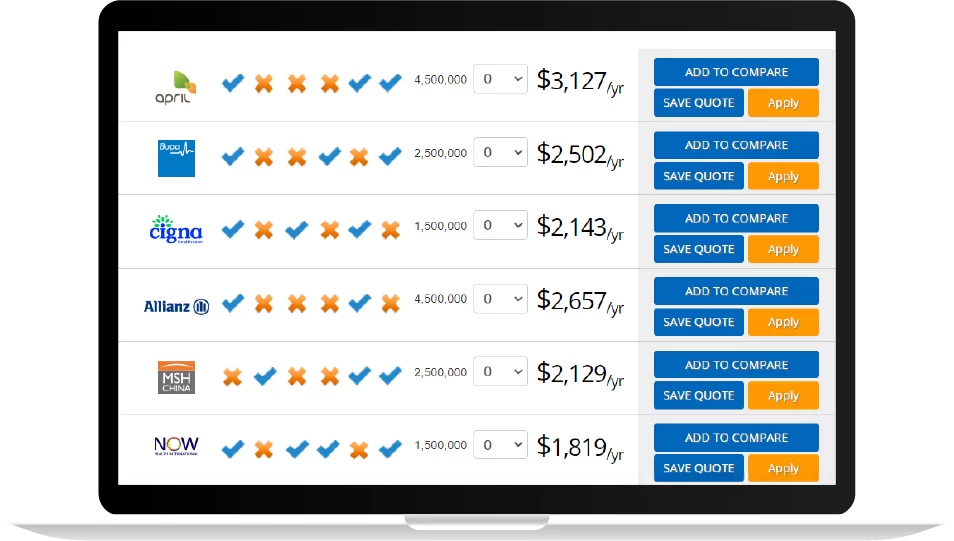
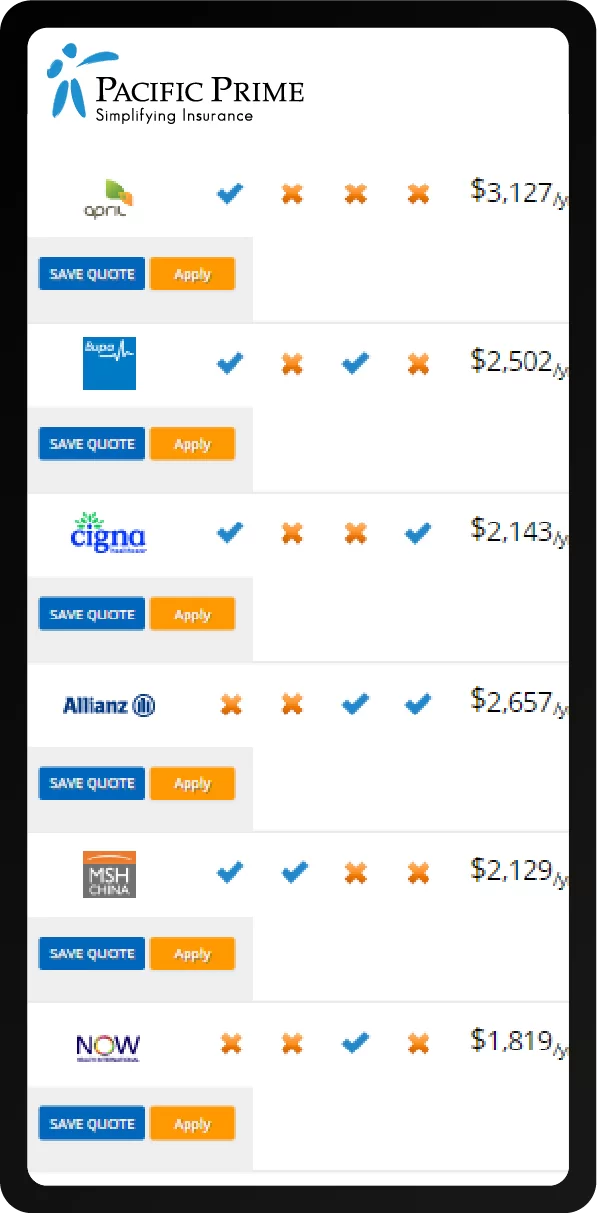
The best way to see what you can get for your health needs is to get quotes for plans you’re considering. Pacific Prime offers a free quote tool where you can compare quotes from top providers and hundreds of plans.
Step Three: Consider Add-On Riders
One way to customize a plan to your lifestyle and budget is to consider any add-on riders offered by your provider. For example, dental benefits are often excluded from basic plans but can be added as a rider.
Step Four: Complete the Online Application
You’ve picked your plan, and you’re ready to move forward, so submit a formal application on the provider’s website. This generally requires submitting information such as your age, gender, and health history.
Always be honest, especially about any pre-existing conditions you may have to avoid denied claims in the future, which can result in costly out-of-pocket expenses for you.
Step Five: Review Terms and Finalize Your Plan
Expats who have been approved for a plan should carefully read through the terms and conditions of the offered plan. Some plans come with exclusions, waiting periods, and moratoriums for certain benefits, such as maternity benefits or pre-existing condition coverage.
Once you’ve reviewed your plan conditions thoroughly, submit payment and start receiving coverage! You will choose whether to pay monthly or annually.
How to Pick the Right Health Insurance Plan for Brazil
Most expats use Brazil’s public SUS coverage for vaccinations and emergencies while relying on private insurance for more specialized care. However, each expat is different, so here are the most important considerations when picking insurance.
- Range of Benefits: Look for comprehensive coverage that includes inpatient and outpatient services, preventive care, maternity, mental health services, and prescription medications.
- Pre-Existing Conditions: SUS coverage includes treatment for pre-existing conditions for free, but it can be hard to get into public specialists quickly. In contrast, many private plans offer coverage for pre-existing conditions only after a given waiting period.
- Exclusions: Review the policy exclusions carefully, as many plans may not cover specific pre-existing conditions or certain treatments, leading to unexpected out-of-pocket costs.
- Local vs. Regional vs. International Coverage: If you plan to spend most of your time in Brazil, a local or regional plan may suffice and would help lower the cost of your plan. If you plan to travel frequently, an international plan is advisable so that you’re covered wherever you are.
- Waiting Periods: As mentioned above, private plans often require a waiting period for higher-risk benefits for the insurance company, such as pregnancy or other pre-existing conditions. Always check with a provider about waiting periods before securing a plan.
- Language Assistance Needs: If you don’t speak Portuguese, an international plan is highly recommended. Brazil has very few public system doctors who speak English, while international networks cater to expats with translation services and many English-speaking doctors.
- Cost: Your premium, deductible, copayments, and out-of-pocket maximums all work together to determine how much you’ll pay each month for insurance and how much you’ll pay whenever you get medical services.
- Coverage Limits: Assess the maximum amount the insurer will cover for medical expenses to ensure it meets your needs, especially if you expect extensive care.
- Convenience: If receiving care quickly and having comfortable accommodations like private hospital rooms are important to you, SUS coverage will likely not be preferable for you. Private coverage offers faster and more exclusive care.
- Provider Network: A larger network of medical providers enhances access to various hospitals and clinics, reducing wait times and improving care quality.
- Claims Process: Direct billing means your medical expenses will be directly paid by your insurer, easing financial stress for you. In contrast, some providers require that you pay upfront for your medical treatment, then submit a claim for reimbursement.
- Insurer Reputation: Research the insurer’s reputation through feedback and ratings from current policyholders to gauge reliability and customer service.
- Adventure Activities and Support: If you plan to engage in adventure activities, confirm that the policy covers them and that the insurer offers 24/7 emergency assistance for urgent situations.
- Medical Evacuation Coverage: Ensure the plan includes coverage for medical evacuation, which can cover transportation costs and logistical support if you need to be moved for medical treatment or to return to your home country.
- Repatriation of Remains: Repatriation of remains covers the cost of transporting your body back to your home country in the event that you die while in Brazil. This coverage is common in international plans but not in SUS coverage.


Get Help from a Broker to Get Health Insurance in Brazil
An international health insurance broker like Pacific Prime helps you find the best plan for your personal health needs as an expat in Brazil. Whether they’re quoting and comparing plans or finding the plans that maximize your budget, brokers simplify the process of picking health insurance.
One of the key benefits of working with an insurance broker is that a broker represents the client, not the insurance companies. That means they can easily quote and compare different plans from multiple providers to find one that best suits your needs.
Insurance Brokers Handle Administrative Tasks
One of the benefits of working with an insurance broker is that there are fewer administrative tasks for you: brokers can correspond with insurers on your behalf, manage policy documentation, help process your claims, and more.
Insurance Brokers Offer Continuous Support
You remain a client of your selected insurance broker after you secure the policy. The broker will continue to assist you in renewing your plan, updating it, and filing claims. You’ll be able to reach out with questions and receive support from your insurance broker.
Insurance Brokers Offer Personalized Options and Market Insights
Insurance brokers are experts on policy options and market trends. You’ll be able to customize plans based on your budget and needs because an insurance broker will help you secure the best fit for your life in Brazil.
Insurance Brokers Advocate and Mediate on Behalf of Policyholders
Your broker will support you and work to keep your loyalty. Since they also understand the terminology of insurance and specialize in Brazilian markets, you’ll have much more security with an expert advocate in your corner.
Brazil’s Healthcare System Explained for Expats

Brazil’s government oversees all healthcare policy, including the Unified Health System (Sistema Único de Saúde/SUS), but the decentralized system gives each individual state and municipality the responsibility for running and distributing care in their area.
Brazilian citizens, residents (including expats), and even visitors can get free, comprehensive public care in public facilities through Brazil’s SUS scheme. While Brazil is known for having good healthcare, that healthcare can be difficult to access, with wait times known for being long.
Expats who are not comfortable speaking Portuguese should also note that it can be difficult to find doctors in the public healthcare system who speak other languages. English-speaking doctors are much more common in the private sector.
To find out more about the quality of medical care in Brazil, check out our article on the subject.
Public healthcare through SUS in Brazil is comprehensive, meaning expats and other Brazilian residents can fulfil most, if not all, of their healthcare needs through this system. Below is an extensive list of the benefits offered:
- Blood therapy
- Dental care
- Dialysis
- Home care
- Hospitalization
- Lab tests
- Maternity care
- Medical equipment, such as wheelchairs and hearing aids
- Mental health services
- Oncology services
- Organ transplants
- Physical therapy
- Preventative services
- Prescription drug coverage (for approved medications)
- Surgery
- Vaccinations
- Vision care
- Visits to specialists and general practitioners
Private Healthcare in Brazil
Private healthcare is popular in Brazil, even with the country’s free SUS system. The private sector offers better quality of care and top-notch facilities without the drawbacks of extensive wait times, no English-speaking doctors, and variable quality found in the public sector.
Private insurance gives expats access to private medical care, but all private plans must meet requirements set by the National Agency for Supplementary Health (ANS). ANS is distinct from the Ministry of Health and is in charge of regulating and authorizing health insurance plans in Brazil.
ANS requirements for private insurance plans are laid out in their Rol de Procedimentos, which includes a list of over 3,000 items, from basic doctor checkups to complex cancer treatments.
Frequently Asked Questions
Can foreigners get free healthcare in Brazil?
All residents in Brazil, including expats, have access to free healthcare through the country’s public SUS system.
How can expats access healthcare in Brazil?
Expats can access free healthcare services at public facilities by registering for a National Health Card (CNS) using their Cadastro de Pessoas Físicas (CPF). Many also opt for private health insurance for quicker access to care and to avoid long waits in public hospitals.
Conclusion
Expats who are looking for health insurance for Brazil should register for public coverage because it is simple and offers options for free, quality medical care. Getting private insurance coverage on top of SUS offerings is advisable since the application is simple and offers access to quicker care.
If you’re still concerned about getting your health insurance right abroad, let the brokers at Pacific Prime help you. Pacific Prime has over 25 years of experience helping individuals, families, and businesses find the exact plan for their health needs and budget.
With international market understanding, they can make finding personalized plans simple. Call
+1 (332) 222 3909 or contact us for free, no-obligation assistance today.
Suggested Reading:
- Health Insurance in Brazil for Expats: SUS, Private & International Options
- SUS Healthcare in Brazil: Free Public Healthcare for Expats
- Medical Emergencies in Brazil: What Expats Need to Know

Serena earned her Bachelor’s Degree in Psychology from the University of British Columbia, Canada. As such, she is an avid advocate of mental health and is fascinated by all things psychology (especially if it’s cognitive psychology!).
Her previous work experience includes teaching toddlers to read, writing for a travel/wellness online magazine, and then a business news blog. These combined experiences give her the skills and insights she needs to explain complex ideas in a succinct way. Being the daughter of an immigrant and a traveler herself, she is passionate about educating expats and digital nomads on travel and international health insurance.
- An Expat’s Guide To East Coast Singapore - November 3, 2026
- Hospitals in New Zealand for Expats & Visitors (2026 Guide) - October 16, 2026
- Top 9 Health Insurance Companies for Expats in Malta - October 7, 2026

Comments
Comments are disabled for this post
We'll notify you
when our team replies!