
Five “Health” Products You Really Don’t Need in 2026
More often than not, we don’t really need detox teas, collagen supplements, sports drinks, multivitamins, or functional mushroom powders to better our health, though marketers would do everything they can to have you believe otherwise.
Discover the world's top
health insurers.
Compare quotes with
a click of the button.
With more people than ever trying to find easy and simple ways to become healthy, the demand for health products has never been higher. While there have been many legitimately useful health products produced, a lot of them have been rather useless and hilariously over-marketed.
In this Pacific Prime article, we’ve taken five of these products and compiled a list of “five health products that you really don’t need,” but we’ll also name one product that can have a crucial bearing on your health: health insurance.

Five “Health” Products Most of Us Really Don’t Need
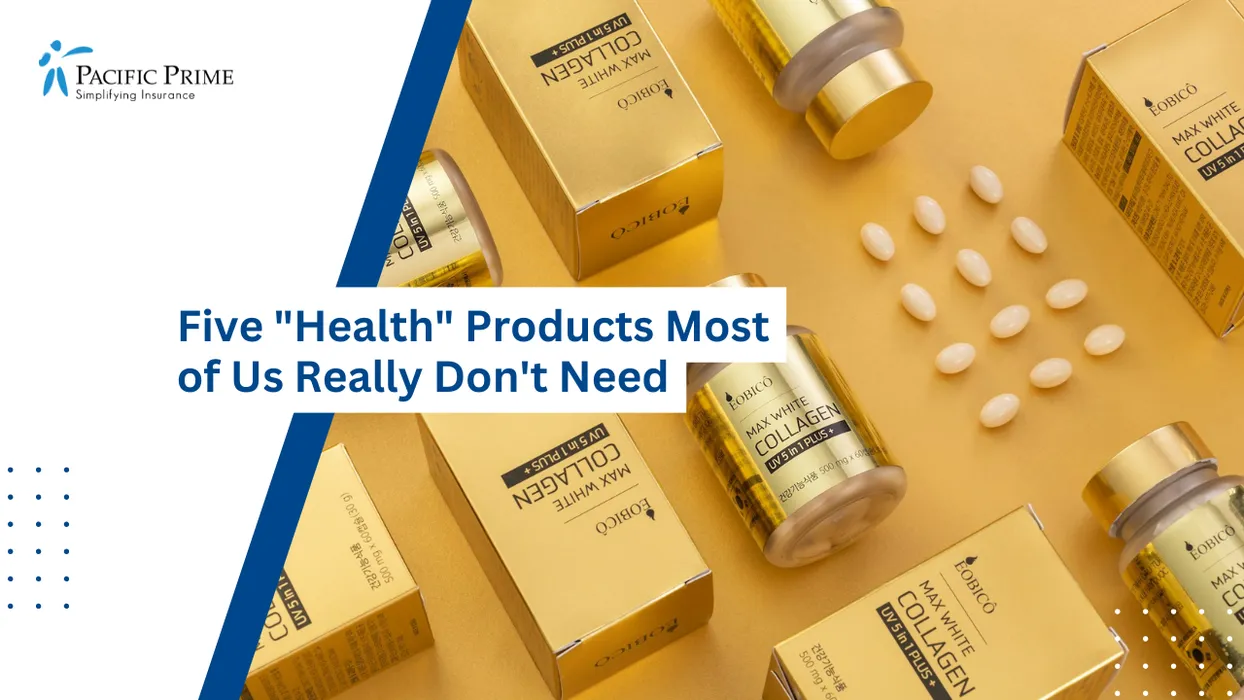
Most people don’t actually need detox teas, collagen supplements, sports drinks, multivitamins, or functional mushroom powders to improve their health, even though marketers try every trick to convince you otherwise.
Detox Teas
Detox teas are a health product that most people really do not need because the body already has a built-in detox system. The liver, kidneys, lungs, and digestive tract continuously remove waste and process substances we consume, so a tea cannot “cleanse” the body in any special way.
In practice, the main short-term effect of many detox teas comes from caffeine or herbal laxatives, which may cause a temporary drop on the scale through water loss rather than actual fat loss.
The bigger issue is that these products can create more problems than they solve. Reports and medical reviews have linked detox teas to side effects such as diarrhea, stomach cramps, dehydration, and electrolyte imbalance.
In severe cases, excessive use of certain ingredients has even been associated with serious complications like hyponatremia, a dangerous condition caused by abnormally low sodium levels. That makes detox teas a poor choice for anyone looking for safe, sustainable health support.
There is also little credible evidence that they improve long-term health outcomes. Most benefits are marketed rather than proven, and the “detox” promise is often built on vague claims instead of solid clinical data.
For people hoping to feel better or manage weight, basic habits such as drinking enough water, eating more fiber, sleeping well, and exercising regularly are far more effective and far less risky.
In short, detox teas are not a necessary wellness product; they are usually an expensive shortcut with limited upside and real downsides.
Collagen Supplements
Collagen supplements are often marketed as a shortcut to better skin, joints, and overall wellness, but your body already breaks down dietary protein into amino acids and then uses those building blocks to make collagen where needed, so taking collagen is not required for a healthy collagen level.
That said, the research is mixed. Some recent reviews have found possible improvements in skin hydration, elasticity, and wrinkles, but those findings do not make collagen essential, and many studies are small, short-term, or funded in ways that raise bias concerns.
For joint health, the evidence is still developing and not strong enough to justify treating collagen as a must-have daily product for the average person. In other words, the benefits may exist for some people, but they are not universal or necessary.
Another reason collagen supplements are easy to overbuy is that they can sound more special than they are. If someone already eats enough protein from foods like fish, eggs, dairy, soy, beans, or lean meat, they are already giving the body the raw materials it needs to build and maintain collagen.
For most healthy adults, the bigger wins for skin and joint health come from sleep, hydration, sun protection, exercise, and a balanced diet, not a pricey powder or capsule. So while collagen supplements may have a place for some users, they are far from a health product people really need.
Sports Drinks (for Ordinary Workouts)
Sports drinks are a health product that most people do not need for ordinary workouts because they are designed for situations that involve long duration, heavy sweating, or intense endurance performance.
For a typical gym session, jog, or fitness class, plain water is usually enough to replace the fluid lost through sweat. Sports drinks mainly add sugar, sodium, and sometimes caffeine or other additives, which can be unnecessary if you are not exercising hard enough to justify them.
Many treat these drinks as a default “exercise drink,” but the body doesn’t need that level of replacement for moderate activity. A standard sports drink can contain around 20 to 30 grams of sugar per bottle, so you may be taking in extra calories without getting a meaningful performance benefit.
That matters because frequent use can quietly add to daily sugar intake, especially for people who drink them after short workouts or while going about normal daily routines.
Research and public health guidance generally point to water as the best choice for most everyday exercise, while sports drinks are better reserved for longer or more intense sessions where fluid, carbohydrate, and electrolyte replacement actually becomes important.
In other words, the average person is paying for a product built for athletes in demanding conditions, not for casual workouts.
For most healthy adults, better hydration habits are simple: drink water before, during, and after exercise, and eat a balanced diet. That is cheaper, cleaner, and more effective than relying on a sugary performance drink that offers little advantage in ordinary training.


Most Multivitamins (If the Diet Is Already Balanced)
Most multivitamins are a health product that people really do not need if their diet is already balanced. A varied diet can often provide the vitamins and minerals you need, and large reviews have found little evidence that routine multivitamin use improves overall health for well-nourished adults.
In practical terms, if someone regularly eats fruits, vegetables, whole grains, protein sources, and dairy or fortified alternatives, they are likely already getting enough micronutrients from food.
Moreover, multivitamins can create a false sense of security. People may assume one pill can “cover” a poor diet, but vitamins are not a substitute for the fiber, protein, healthy fats, and protective plant compounds found in real food.
Nutrition is about more than avoiding deficiencies. A balanced diet supports digestion, energy levels, heart health, and long-term disease prevention in ways a supplement cannot fully replicate.
Cost and unnecessary dosing are other issues. Many multivitamins contain nutrients at levels far above daily requirements. Some formulations may deliver doses that are simply excreted, while others can become unhelpful or even risky when taken alongside additional supplements or fortified foods.
That is especially relevant for fat-soluble vitamins such as A, D, E, and K, which can accumulate in the body more easily than water-soluble vitamins.
For most healthy adults with a balanced diet, multivitamins are optional at best, not essential. They may be useful in specific situations, such as diagnosed deficiencies, pregnancy, or restricted diets, but as an everyday “insurance policy,” they are usually unnecessary.
“Functional” Mushroom Powders Marketed as Wellness Cures
“Functional” mushroom powders are a health product most people really do not need because the wellness claims usually outpace the evidence. In other words, they are sold as if they are essential, when in reality they are mostly optional novelty products.
These powders are often marketed as if they can boost immunity, sharpen focus, reduce stress, or improve energy, but for many of those promises, the human evidence is still limited, inconsistent, or based on small studies rather than strong clinical proof.
Another problem is that mushroom powders are typically expensive for what they deliver. A spoonful of powder may sound sophisticated, but it often provides only tiny amounts of the active compounds that matter, if those compounds are present at all in meaningful doses.
Some products also do not clearly disclose the species used, extraction method, or amount of beta-glucans and other constituents, making it hard for consumers to know what they are actually buying. That lack of transparency is a red flag in a market built on big claims.
Traditional medicinal use and modern wellness marketing are also different. Mushrooms can be part of a healthy diet, and certain mushroom-derived compounds are being studied for specific medical uses, but that does not mean a powdered “superfood” blend is necessary for everyday health.
For most people, the basics still matter more: sleep, exercise, a balanced diet, and stress management.
Put simply, functional mushroom powders are usually a costly shortcut in search of a problem. Unless someone has a specific, evidence-backed reason to use them, they are not a health product people really need.
So keep these dubious “health” devices in mind the next time you find yourself watching some terrible TV infomercials. More likely than not, the device you’re looking at probably won’t be the magic health bullet that you’re looking for.
Frequently Asked Questions
Why are detox teas considered unnecessary for most people?
Detox teas are usually unnecessary because the body already has organs that remove waste naturally. Any quick weight change is often water loss from laxative ingredients, not true fat loss. They can also cause unpleasant side effects such as dehydration, cramps, and electrolyte imbalance.
Do collagen supplements replace what a balanced diet already provides?
Collagen supplements are not usually needed. If a person already eats enough protein from foods like fish, eggs, beans, dairy, or soy, the body has the raw materials it needs to make collagen. Supplements may be marketed as essential, but for most healthy adults, they are optional and not necessary.
What is the main problem with functional mushroom powders?
The main issue is that the marketing often sounds stronger than the evidence. Claims about immunity, focus, or stress relief are not always supported by solid human research. Many powders are also expensive and may not clearly state how much active ingredient they actually contain.

What You Can Do for Your Health and Well-being
As you can see from the above points, there is no magic product that would make you healthy, fit, younger, or more energetic. To achieve this, you have to put in a bit more effort and adjust your lifestyle to a healthier one.
Following a healthy diet and exercising regularly are good points to start that can work towards better overall wellbeing.
Another important aspect of well-being is access to healthcare and regular health check-ups. If a doctor spots any condition during a check-up, you’ll have better chances of managing it or avoiding the disease or health condition from developing into something serious. As they say, prevention is key!
Health is important, and with international health insurance companies tending to exclude any pre-existing conditions from the coverage, we believe that planning long-term is a better option than spending money on detox teas or collagen supplements.
Here at Pacific Prime, we are experts in advising on health insurance plans worldwide. If you have any questions on the insurance subject, feel free to get in touch with us anytime!

Since joining Pacific Prime, Martin has become even more aware of the gap between the true value of insurance products and most people’s appreciation of it, and developed a passion for demystifying and simplifying matters, so that more people get the protection they need at a cost they can easily afford.
In his free time, Martin attends concerts of various genres, and plays the violin with piano accompaniment he pre-recorded himself or played live by his niece.
- The Cost of Living in the United Kingdom in 2026 - May 29, 2026
- Life in Shanghai as an Expat in 2026 - May 22, 2026
- Living Abroad in Shanghai in 2026: Cost of Living and Steps to Move - May 20, 2026

Comments
3 Comments
Diet Water is the biggest scam ever, how people can be so stupid? :))
Are there any specific health products that are particularly beneficial for adapting to the Thai climate and lifestyle?
Hi George,
Adapting to Thailand’s tropical climate and active lifestyle can be made easier with health products like high-SPF sunscreen to protect against strong UV rays, electrolyte drinks to stay hydrated in the humid weather, and mosquito repellents to prevent insect-borne diseases. Additionally, probiotics or digestive supplements can be helpful for expats adjusting to local food and water conditions. Regular health check-ups and comprehensive health insurance, including access to outpatient and preventive care, are also key for maintaining well-being in Thailand.
For tailored advice on health coverage options that suit your lifestyle in Thailand, visit our Contact Us page.
Ask a Question
We'll notify you
when our team replies!